
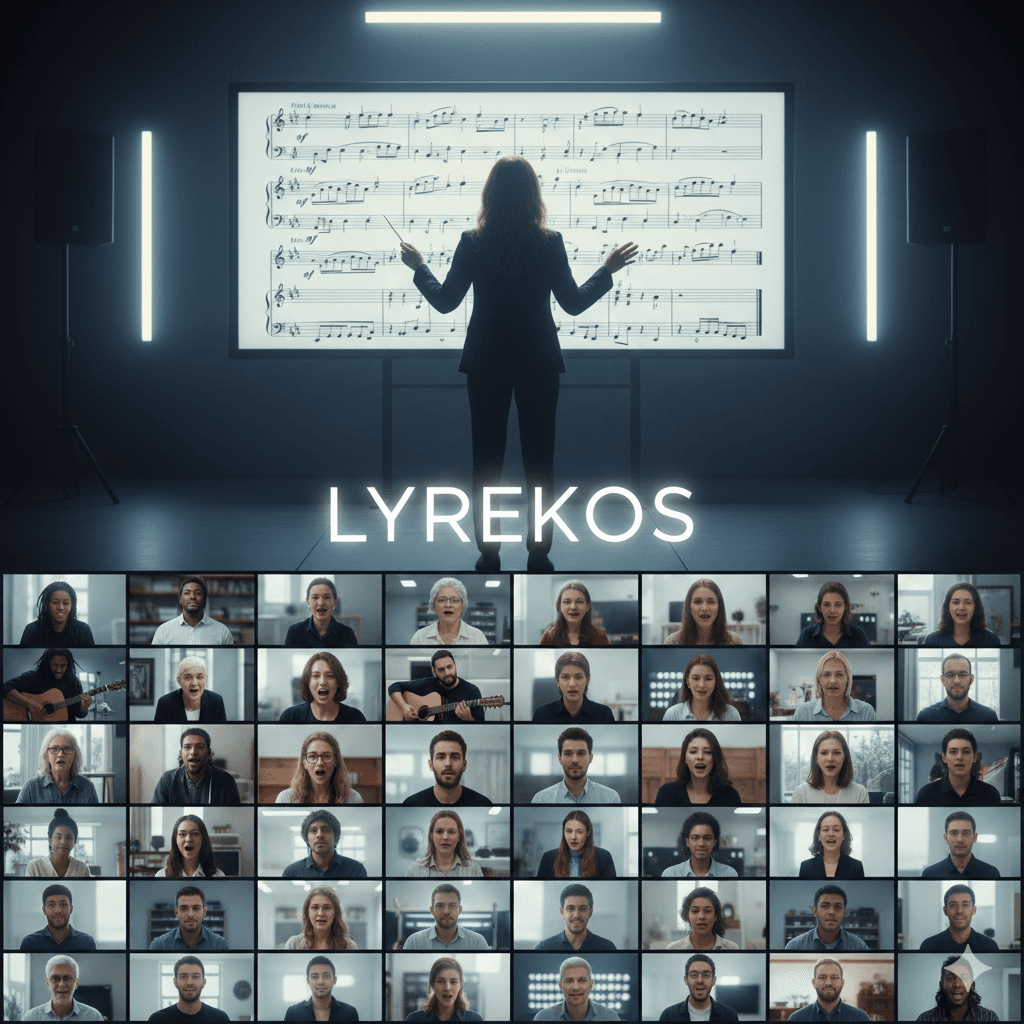
Every music teacher knows the fundamental cycle: demonstrate, guide practice, listen to the student perform, give feedback, repeat. It's how we've taught music for centuries. And during COVID, it broke completely.
The problem wasn't video quality or audio fidelity. The problem was latency—the delay between when you sing a note and when your student hears it. For speech, a 200-millisecond delay is barely noticeable. For music, it's catastrophic. Research shows that ensemble performance requires synchronization within 20-30 milliseconds. Typical internet delays are 5-10 times that.
That's why Zoom choir rehearsals turned into cacophony. That's why online piano lessons meant never playing duets with your student. The internet broke the teaching cycle.
As I described in our founding story, the idea for Lyrekos came from exactly this frustration — trying to sing together over Zoom during COVID and discovering it was impossible.
The Circle of Teaching
Music education fundamentally relies on an iterative cycle. The teacher demonstrates. The student practices with guidance. The student performs independently. The teacher provides feedback. Round and round, with each cycle building skills and musicianship.
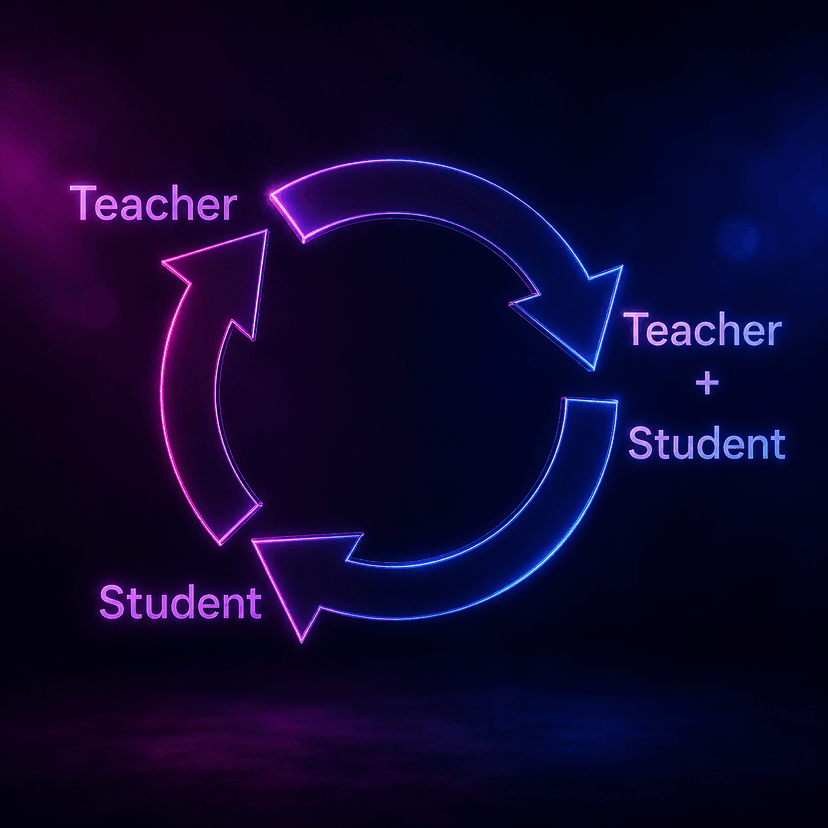
Remote music teaching requires preserving this interaction. But how do you preserve it when internet latency makes synchronized performance impossible?
A Different Approach
Lyrekos takes a fundamentally different approach to the latency problem. Instead of trying to minimize delay (which physics won't allow over long distances), we eliminate the need for real-time synchronization entirely.
Here's how it works for teaching:
Step 1: Teacher records a demonstration. You play or sing the passage, and Lyrekos captures it as a reference track. This becomes the temporal anchor for everything that follows.
Step 2: Student performs along with the recording. The student hears your demonstration and plays along with it—just like practicing with any backing track. But here's where it gets interesting.
Step 3: Lyrekos synchronizes everything. Each participant's audio is recorded with precise timing information. Our system then computationally aligns all the tracks, compensating for whatever delays the internet introduced.
Step 4: Everyone hears the synchronized result. The final mix sounds like everyone performed together in the same room. The teacher's demonstration and the student's performance are perfectly aligned—within about 11 milliseconds, well under the threshold for perceptual ensemble tightness.
What This Enables
With synchronized remote performance, the teaching cycle works again:
- Remote ensemble rehearsals for band, choir, and chamber groups. Students can actually hear how their part fits with everyone else's.
- Individual lessons with accompaniment. Play duets with your piano students. Sing harmony with your voice students. The musical context that makes lessons come alive.
- Sectional rehearsals without physical co-location. Your altos can practice together on Tuesday night even though they live in three different towns.
- Hybrid instruction where some students are in the room and others are remote—and everyone can perform together.
- Assessment of ensemble skills in distributed settings. You can actually evaluate whether a student can maintain their part against other voices.
No Special Equipment Required
One of the most important aspects of Lyrekos for educators is what you don't need. The system runs entirely in a web browser—Chrome on a laptop, tablet, or smartphone. No software to install. No specialized audio interfaces. No IT department involvement.
This matters enormously for equity. The students who most need access to quality music education—in rural areas, in under-resourced schools—are exactly the students who don't have access to specialized equipment. If a student has a device that can run Zoom, they can use Lyrekos.
In our testing, the system worked equivalently across MacBooks, Windows laptops, tablets, and phones. All connections were via regular residential Wi-Fi. We've tested with participants in the same building and participants on opposite coasts. The synchronization accuracy stayed consistent regardless of distance—because we're not fighting the speed of light, we're sidestepping it.
Limitations to Know About
I want to be honest about what Lyrekos can and can't do, because understanding the limitations helps you use it effectively.
The system requires a reference track—a backing track or pre-recorded demonstration. This is what allows the synchronization to work. You can't have a completely spontaneous, free-form jam session where everyone responds to each other in real time. The physics of the internet won't allow that.
However, structured improvisation works fine. Jazz students can solo over a backing track. Call-and-response exercises work. Anything where there's a rhythmic reference that everyone follows will synchronize correctly.
Think of it this way: Lyrekos is for a somewhat prepared performance, not completely spontaneous conversation. One doesn't need a lot of structure, but one does need some.
This same principle applies in surprising places. In our post on choral speaking, we explore how educators have long used synchronized group voice — for ESL instruction, fluency therapy, and public speaking confidence — and how Lyrekos makes that possible across any distance.
Curious about all the ways Lyrekos can be configured? Our post on Lyrekos’ flexible building blocks walks through every operating mode — Conversation, Live, Unison, and Playback — with diagrams showing exactly how audio flows.
If you teach private lessons, you might also enjoy our post on teaching music 1:1 over the internet in perfect sync, which walks through exactly how a one-on-one lesson sequence works with Lyrekos.
And for the other side of remote rehearsal — the students who simply do not turn up — our post on the most memorable excuses choir directors have heard collects the finest of them, and makes a serious point about why a choir notices an absence immediately.
Getting Started
We're currently preparing Lyrekos for its first users—music educators and worship teams who felt the loss of synchronized remote performance most acutely during COVID and are still looking for solutions.
If you're a music educator interested in trying Lyrekos with your students, I'd love to hear from you. We're looking for teachers who want to help us refine the experience before broader release.
Join our community and let us know about your teaching situation. We'll be in touch as we roll out access.
The pandemic revealed how much we'd taken for granted about making music together. Lyrekos is our attempt to bring that back—not as a replacement for the magic of being in the same room, but as a bridge across the distances that keep us apart.
Lance Glasser
Lance is CEO and Co-founder of Kinetic Audio Innovations. He was previously a faculty member at MIT, Director of the Electronics Technology Office at DARPA, and CTO at KLA. He also makes sculpture, which has nothing to do with audio but explains the hundreds of pounds of bronze in his house.
Interested in Teaching with Lyrekos?
Join our community to get early access for music educators.
Join our CommunityTry it